Emotional Marketing in 2026: How to Sell Without “Selling”
Think about your last big purchase.
Did you buy it because of features… or because of how it made you feel?
The truth is simple—people buy with emotions and justify with logic.
In 2026, successful marketing is not about pushing products.
It’s about creating an experience so powerful that customers already feel the benefit before buying.
Understanding Consumer Psychology in 2026
Modern consumers are smarter—but still emotional.
They don’t just ask:
- “What does this product do?”
They ask:
- “How will this improve my life?”
👉 That’s where emotional marketing wins.
🔍 Key Insight (Featured Snippet Ready)
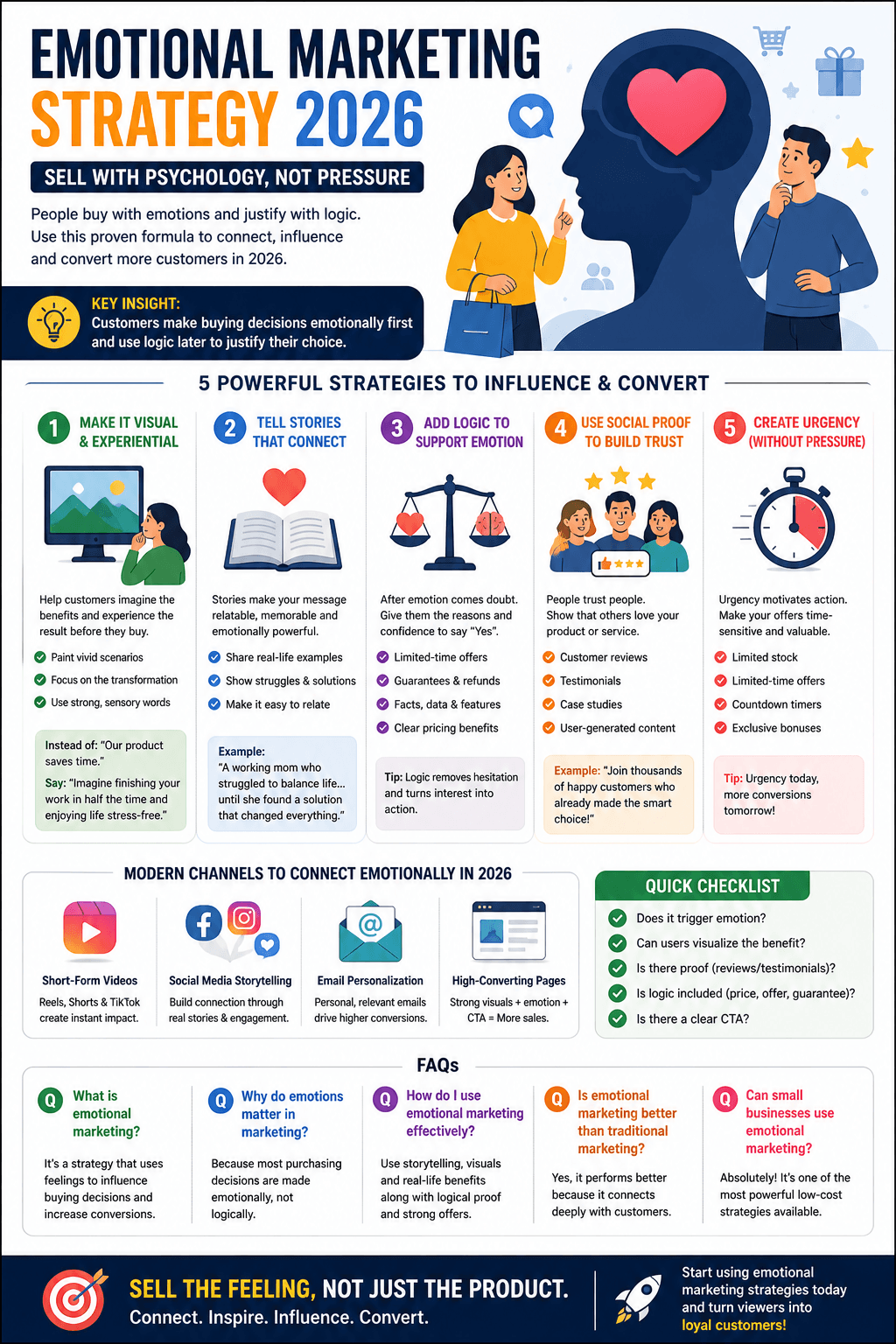
Customers make buying decisions emotionally first and use logic later to justify their choice.
Why Emotional Marketing Works So Well
Emotions drive action.
When your marketing connects emotionally, it:
- Builds instant trust
- Creates desire
- Increases conversions
- Strengthens brand loyalty
👉 Logic supports the decision—but emotion makes it happen.
Strategy 1 – Make It Visual and Experiential
Don’t just describe your product—show the experience.
Instead of saying:
❌ “Our product saves time”
Say:
✅ “Imagine finishing your work in half the time and spending evenings stress-free with your family.”
✔️ How to Apply This:
- Use storytelling
- Paint vivid scenarios
- Help customers visualize success
👉 When customers can “see” the result, they want it.
Strategy 2 – Tell Stories That Connect
Stories sell better than facts.
Example:
Instead of listing features, tell a story like:
“A working mom who struggled to balance life… until she found a solution that gave her both time and income.”
👉 Stories make your message:
- Relatable
- Memorable
- Persuasive
Strategy 3 – Add Logic to Support Emotion
After emotion comes doubt.
Customers often think:
- “Did I make the right decision?”
That’s where logic comes in.
Strategy 4 – Use Social Proof to Build Trust
People trust people.
When customers see others benefiting, they feel safer buying.
Include:
- Reviews
- Testimonials
- Case studies
- User-generated content
👉 “Others are happy → I will be too.”
Strategy 5 – Create Urgency Without Pressure
Urgency drives action—but must feel genuine.
Examples:
- “Limited-time offer”
- “Only 50 spots available”
- “Offer ends tonight”
👉 This reduces hesitation and boosts conversions.
Modern Emotional Marketing Channels (2026)
Use platforms where emotions connect fastest:
- Short-form videos (Reels, Shorts)
- Social media storytelling
- Email campaigns with personalization
- Landing pages with strong visuals
👉 Combine emotion + technology for maximum impact.
Quick Checklist for High-Converting Ads
Before launching your campaign, check:
- ✔️ Does it trigger emotion?
- ✔️ Can users visualize the benefit?
- ✔️ Is there proof (reviews/testimonials)?
- ✔️ Is logic included (price, offer, guarantee)?
- ✔️ Is there a clear CTA?
FAQs About Emotional Marketing
Q1: What is emotional marketing?
It’s a strategy that uses feelings to influence buying decisions and increase conversions.
Q2: Why do emotions matter in marketing?
Because most purchasing decisions are made emotionally, not logically.
Q3: How do I use emotional marketing effectively?
Combine storytelling, visuals, and real-life benefits with logical proof.
Q4: Is emotional marketing better than traditional marketing?
Yes, it performs better because it connects deeply with customers.
Q5: Can small businesses use emotional marketing?
Absolutely. It’s one of the most powerful low-cost strategies available.
🏁 Conclusion: Sell the Feeling, Not Just the Product
In 2026, marketing success comes down to one thing—connection.
If your audience can:
- Feel it
- See it
- Believe it
👉 They will buy it.